
The Korean War, often overshadowed by its flashier siblings like World War II and the Vietnam War, kicked off on June 25, 1950. Picture this: a divided peninsula, political tensions simmering, and then—boom! North Korea decides to crash the party by invading the South. It’s like the world’s worst game of tag, but with tanks and a whole lot of geopolitical drama.
This conflict not only reshaped Korea but also sent shockwaves across the globe, drawing in superpowers and changing alliances overnight. It’s a fascinating chapter in history that reminds us how quickly things can escalate. So buckle up as we dive into the timeline of events that led to this pivotal moment and explore why it still matters today.
Overview of the Korean War
The Korean War marked a significant event in 20th-century history. It began when North Korea launched an invasion on June 25, 1950, following years of escalating tensions. This invasion led to a swift response from South Korea, which, with U.S. support, sought to repel the northern forces.
Both sides quickly became entrenched in conflict. International involvement escalated as the U.S. and other United Nations members supported South Korea, while China and the Soviet Union backed North Korea. The war created a complex battlefield, with fighting occurring across various terrains in Korea.
Key battles, including those at Pusan and Inchon, showcased the war’s intensity and the strategic maneuvering employed by both sides. A crucial turning point occurred when UN forces successfully landed at Inchon, pushing the North Korean army back towards the northern borders. Despite initial successes, a counteroffensive by Chinese forces in late 1950 led to significant setbacks for UN troops.
Stalemate characterized much of the war following the initial offensives. By 1951, trench warfare resembled World War I conditions, with both sides seeking to solidify their positions along the 38th parallel. Political negotiations began in 1951, yet strong ideological divides prolonged the conflict.
The war ultimately came to a halt with an armistice signed on July 27, 1953. No formal peace treaty was established, leaving the Korean Peninsula divided and maintaining a state of tension that persists today. The Korean War forever altered Korea’s landscape and shaped international relations amid the Cold War.
Background Leading to the War
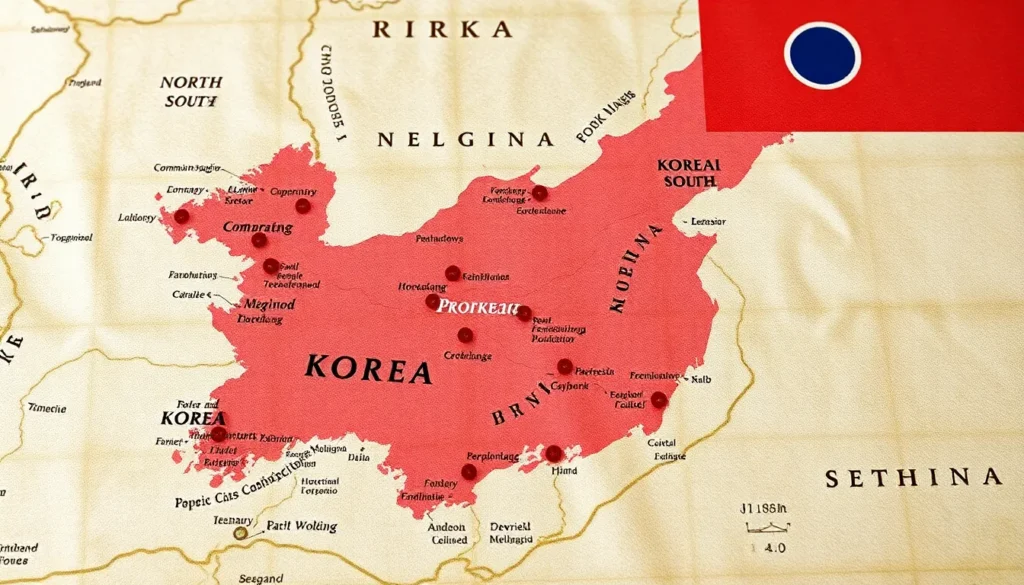
The Korean War’s origins lie in the division of Korea post-World War II and the escalating political tensions between the North and South.
Division of Korea
Korea’s division occurred in 1945, following Japan’s defeat. Two separate zones of occupation emerged, one controlled by the Soviet Union in the North and the other by the United States in the South. This partition resulted in the establishment of two distinct governments: a communist regime in the North and a democratic system in the South. Tensions heightened as both governments sought to unify Korea under their respective ideologies. The division served as a catalyst for conflict, with each side viewing the other’s existence as a direct threat to its sovereignty.
Political Tensions
Political tensions intensified throughout the 1940s. Both North and South Korea engaged in aggressive rhetoric, accusing each other of inciting violence. The ideological confrontation between communism and democracy fueled distrust and hostility. In the North, Kim Il-sung cultivated strong ties with the Soviet Union and China, while Syngman Rhee in the South leaned on U.S. support. Events like border skirmishes and espionage further deepened the divide. As diplomatic efforts failed, the stage was set for armed conflict, which erupted when North Korea launched its invasion on June 25, 1950.
When Did Korean War Start?
The Korean War commenced on June 25, 1950, marking a significant historical conflict on the Korean Peninsula. This invasion catalyzed not only local but also global reactions.
Date of Initiation
On June 25, 1950, North Korea launched its invasion of South Korea. This military action initiated a conflict that would last for three years. The prompt attack aimed to quickly overpower the South and unify Korea under North Korean control. Consequently, the swift nature of the invasion caught the South Korean military off guard. The situation escalated rapidly, leading to international involvement, primarily from the United States under the banner of the United Nations.
Key Events on the Starting Day
The initial hours of June 25 saw heavy artillery shelling along the 38th parallel. In the early morning, North Korean troops crossed the border, advancing towards Seoul. Their primary objective centered on capturing the South’s capital swiftly. Reports indicated that major cities faced aerial bombardments, compounding the chaos. As South Korea scrambled to respond, international forces began mobilizing. Reinforcements from the U.S. arrived almost immediately after the invasion began, signaling a significant commitment to defending South Korea. Efforts to gather intelligence and counter the North Korean offensive initiated soon after.
Impact of the War’s Start
The onset of the Korean War dramatically shifted the political landscape in East Asia. Military actions by North Korea on June 25, 1950, triggered international tensions, prompting immediate responses from global powers. An escalation of hostilities brought the United States, along with United Nations forces, into support of South Korea’s defense. This support marked a significant engagement of U.S. military resources and strategy during the Cold War.
Shifts in alliances characterized this period as countries reassessed their positions. China and the Soviet Union allied strongly with North Korea, viewing the conflict through the lens of communist expansion. The involvement of these superpowers intensified the stakes of the war, embedding the conflict into the broader narrative of Cold War dynamics.
The swift advance of North Korean troops raised concerns throughout the region. Neighboring nations faced potential threats as the prospect of communism expanding grew more tangible. Governments in Southeast Asia reflected on what this conflict could mean for regional stability and their own sovereignty.
Furthermore, the Korean War brought about a wave of military strategy re-evaluation for the U.S. and its allies. Battles such as the Pusan Perimeter and Inchon landings showcased the complexity of modern warfare. These pivotal moments highlighted the interplay of ground and naval strategies while reinforcing the necessity for swift, united action in the face of aggression.
Impacts of the war’s initiation extended beyond military tactics. Economically, countries mobilized resources and manpower in response to the perceived threat. On a political level, debates over containment and potential military intervention dominated discussions in the United States and among its allies. The Korean War thus marked a transformative period, fundamentally altering relationships on the global stage and establishing precedents for future conflicts.
The Korean War’s initiation on June 25, 1950, was a pivotal moment that reshaped not only the Korean Peninsula but also the global political landscape. The swift invasion by North Korea ignited a conflict that drew in superpowers and marked a significant chapter in Cold War history. As the war unfolded, it highlighted the complexities of international relations and the ideological divides that continue to influence East Asia today. The legacy of this conflict remains evident in the ongoing tensions between North and South Korea, serving as a reminder of the far-reaching consequences of military aggression and political rivalry. Understanding the war’s origins and impact is crucial for comprehending today’s geopolitical dynamics.